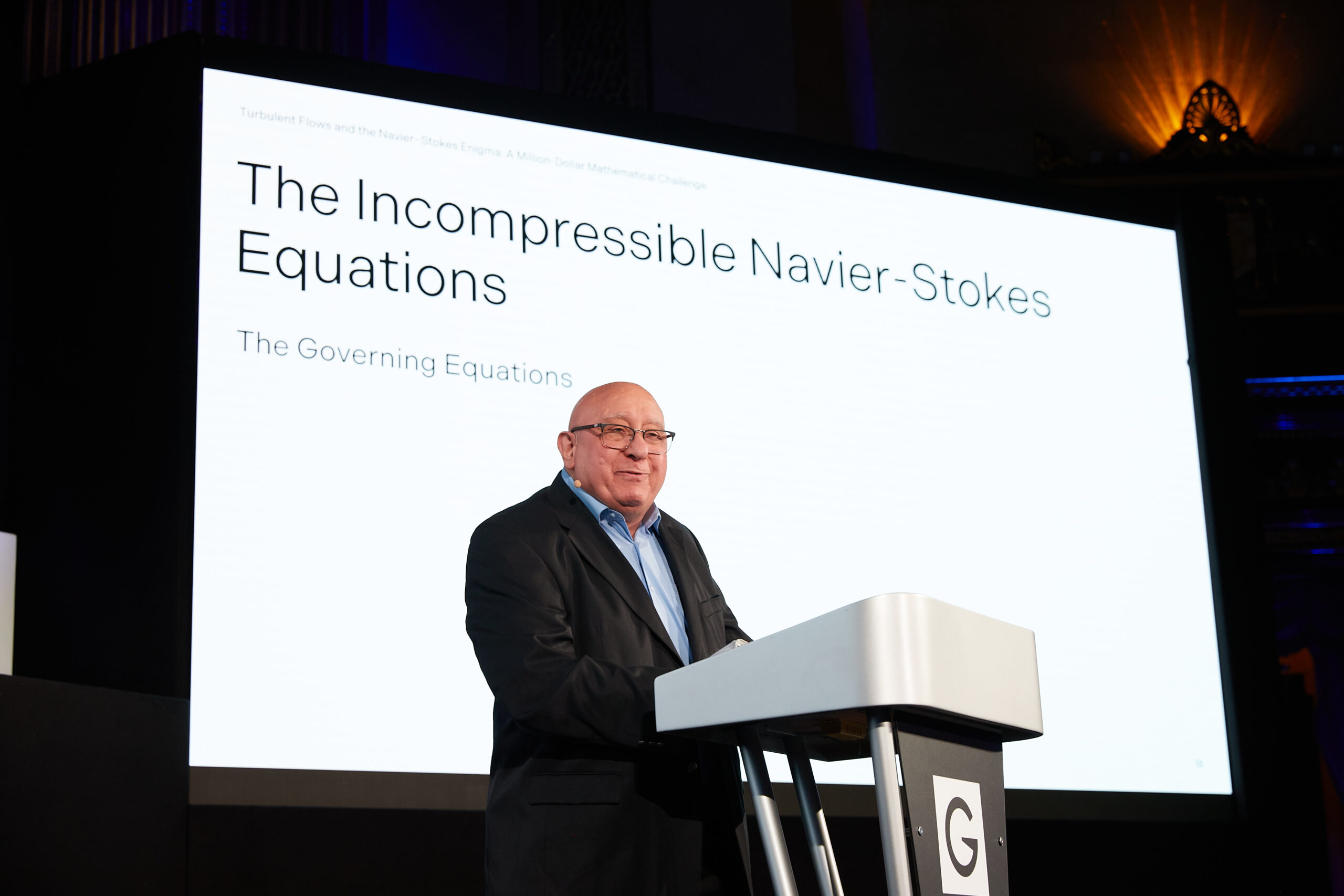
Many times people think that mathematics is about solving equations. Actually, mathematics is about solving problems. I think, uh, many people, uh, especially from the application point of view, like engineering, et cetera, they say, well, airplanes fly. Everything's fine. Why should we care about whether solution exists or not? On the other hand, I mean, addressing the problem, brand new problem, whether solution exists or not, is only one step in trying to understand better the whole role that these equations plays in turbulence theory, in controlling the onset of turbulence, whether we would like to suppress it or whether you would like to trigger it. Navi, your stock equation and oil equation, the equation of fluid, fluid is all around us. By the way, fluid is, could be liquid or gas because fluid is everywhere. The applications are immense everywhere. It starts from basically if you want like aerodynamics, aerospace, like, uh, airplanes, design, and so on and so forth. Applications can be also in combustion theory, in basically having better engine. So sometimes you wanna suppress turbulence like in airplanes to reduce the drag, or people will be not shaky, airplane, or sometimes you wanna trigger turbulence like in many industrial application, like in combustion theory. However, with years, because we are making slow progress with the united stocks, then we start trying to address other questions raised by engineers trying to understand other effects. One thing which is based on my experience, I mean, of course you can prove theorems, you can do mathematical progress, but without understanding these physical significance, implication the impact on the other field. It's difficult to value your result. It is important to keep strong ties with the practitioners, with physicists, with engineers. And if you are not doing fluid or mathematics, suppose you're doing math, biology, then with biologists, if you're doing economy, economist, if you're doing mathematical finance with, you know. So therefore it's important to see the people who are really, the people who are gonna use it toward the end to keep in touch about seeing what's of interest to them. And in fact, if you can interpret your result or help you to interpret your result, or maybe you can really even redirect your research to basically have more impact. Sometimes asking a question and trying to solving it regardless whether you are able to solve it or not, the journey of trying to solve it often become as exciting or as interesting as the problem itself. Many problems in mathematics, like starting from say the, the formal theorem, like X to the power n plus Y to the y, n equal Z to the power N. This question, which is so naive, so simple, looks like why should one inquire about it? But while trying to solve this problem, so many tools developed and these tools have become very impactful and very useful for many disciplines in the cryptology and cryptography and many, many other things, which is, that's the message I would like to convey, that mathematicians ask questions and therefore be given the chance in some sense to pursue the solution. Because eventually in the long run, it pays off.