Many of us are speculating about what comes next when machines start to outperform people. Garry Kasparov, speaking at G-Research in November 2026, could report from experience.
“I am one of the first knowledge workers whose job was displaced by a machine,” he said, “and I survived.”
One of the greatest chess players in history, Kasparov joked that his 1997 defeat by IBM’s Deep Blue was “a great sacrifice for humanity,” given the interest in engineering it had inspired among young people. Few losses can claim such a productive afterlife.
For Kasparov, chess offers a useful correction to the mythology surrounding intelligent machines. “It’s not about solving chess,” he said. “You can’t solve chess. It’s about making fewer mistakes.” Computing power could accomplish extraordinary things, he argued, but brute force eventually encountered diminishing returns.
The real advantage, in his account, comes from pairing more computing power with better human judgement.
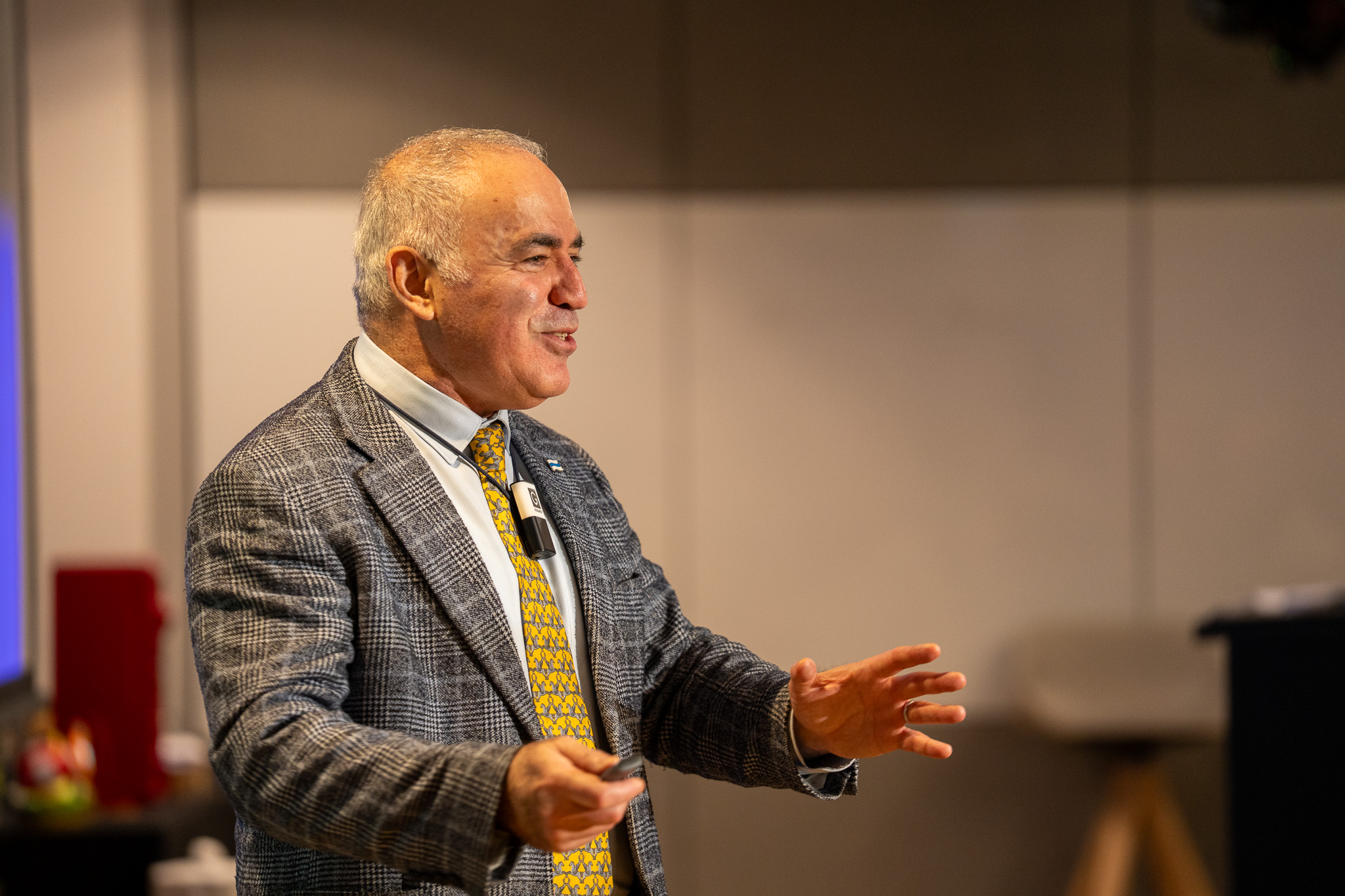
Kasparov’s experiments with human–computer chess teams gave him a way to test what people still brought to the board. In competitions he ran, superior process beat both stronger chess players and faster machines. The advantage lay in how the partners worked together, a helpful finding for businesses considering their own arrangements with AI.
But collaboration also meant understanding what a machine’s answers could – and could not – tell you, Kasparov said. To illustrate this, he quoted Han Solo: “Never tell me the odds”. Machines can calculate chances of success, in other words, but they were less good at describing value.
This was his case for augmented intelligence: machines supplying their formidable powers of calculation, humans deciding what to do with the results. “There’s still room for us,” he said.