G-Research August 2026 grant winners

1 October 2026
  • News

Each month, we provide up to £2,000 in grant money to early career researchers in quantitative disciplines.

Our aim is to support and assist PhD students and postdocs conducting research, particularly with costs that may be difficult to get funding for elsewhere, for example, travel for those who are caring for children, or expenses for volunteer work related to research.

Read on to hear from our latest winners, their research and how our grants will aid their work.

August grant winners

Chiara D’Ercoli (Sapienza University of Rome and the University of Cambridge)
“I am a PhD student at Sapienza University of Rome and the University of Cambridge, focusing on machine learning for complex biological systems modelling.

“My research interests lie in learning low-dimensional representations of molecular phenotypes and modelling their interactions through graphs and dynamical systems.

“I am particularly interested in both data-driven and mechanistic approaches, to combine machine learning with ordinary differential equation models to understand disease processes and potentially predict their evolution.

“The G-Research award will support my research in Cambridge, where I will build on existing collaborations from my previous stays . I am extremely grateful for this opportunity.”

Ferran Hernandez Caralt (University of Cambridge)
“I am a PhD student at the University of Cambridge.

“I work on the theoretical foundations of Deep Learning on Graphs, focusing on Message Passing Neural Networks (MPNNs), their fundamental limitations and their higher-order variants.”

Shanzi Bao  (University of Cambridge)
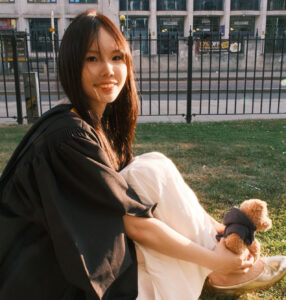
“My research focuses on uncertainty and interpretability in modern machine learning models.

“My recent work investigates how predictive entropy evolves across graph neural network layers and whether it can distinguish different failure modes.

“The G-Research grant will support me in attending Learning on Graphs 2026 to present this work.”

Congratulations to all of our grant winners.

Learn more about our monthly grant terms and conditions.

Banknote displays central dollar sign with rounded corner motifs inside a bold blue rectangular border on a plain white background Want to apply for next month's grant?

Since 2021 we have helped more than 250 students in their studies.

Learn more and see how you can apply.

Learn more

Want to apply?

Complete the form and attach your CV, along with a description of how you’d utilise the funding.

Hear from some of our previous winners

I first got interested in computer science at the age of 13 because I found it fascinating that you could, only from your mind, make stuff work by adding special instructions to a computer, automating a lot of things, and creating new worlds instead of that. That has kept me fascinated ever since. So this is my first conference ever, and the atmosphere is really amazing. There's so many researchers here from both industry and academia, from all areas of the world. I'm working on probabilistic machine learning, diffusion models, and I'm trying to understand the theory of why these models work and how they work. The work I'm presenting at ICML focuses on a problem called model collapse in generative modeling, which is when a generative model gets trained recursively on its own outputs. In my master thesis, we developed a method to steer a large language model's personality into multiple dimensions, and I'm presenting a mechanism that allows this to work so we can change how the LLM answers, not only in one dimension, but multiple ones. So my research can make AI safer by trying to steer the model away from harmful areas. It's such a privilege never to worry about funding when you get to a conference or summer school. The research has supported me very much in my research. They've allowed me to come here to this conference to present my work as a poster here, to meet all of the researchers, so I'm very thankful for that. For me, that's really special, especially as a young researcher. This is my first ever paper I've submitted anywhere, so it gives me great validation that what we've worked on over the past six months is actually useful. It could actually be used for something. It does mean a lot to me. It means that I don't have to apply for other grants. I don't have to lose time looking for funding. It's directly covered by the research. Your research doesn't have to be in the finance field. As long as it's interesting, it advances the field, I think there's nothing to lose then. Just try it out. If the science motivates you enough, do it.
Open video transcript

Latest events

  • Quantitative engineering
  • Quantitative research

Women in Quant Finance 2026

22 Nov 2026 - 23 Nov 2026 1 Soho Place, London, W1D 3BG
  • Quantitative engineering
  • Quantitative research

Melbourne quant challenge 2026

30 Nov 2026 University of Melbourne, Alan Gilbert Building
  • Quantitative engineering
  • Quantitative research

Canberra quant challenge 2026

02 Dec 2026 University of Canberra

Stay up to date with G-Research

Join our talent network

Be the first to hear about new roles and opportunites to join our team.